Why AI Narration Works So Well For Philosophy And Reflection Channels
Something I noticed early on, running faceless channels for English-speaking audiences: in the philosophy, life-lesson and reflection space, viewers do not ask for complicated visuals. What they are unforgiving about is the voice.
Pace, tone, and the silence between sentences. Get those right and someone will stay for twenty minutes on slow landscape footage. Get them wrong and no amount of editing rescues the video.
That is why so many channels in this niche now run on synthetic narration, and why, when it is done properly, most viewers never stop to wonder whether a human read the script.
Why reflective niches suit a synthetic voice
Compare it to gaming, vlogs or reaction content. Those formats are watched. Philosophy, stoicism, life lessons and contemplative content are mostly listened to. The way people consume it is completely different, and that difference decides everything about how you produce it.
In this niche the audience usually presses play late at night with the lights off, or while working on something else, or in the car, or in the last ten minutes before falling asleep. The screen is often face down. The voice is the entire product.
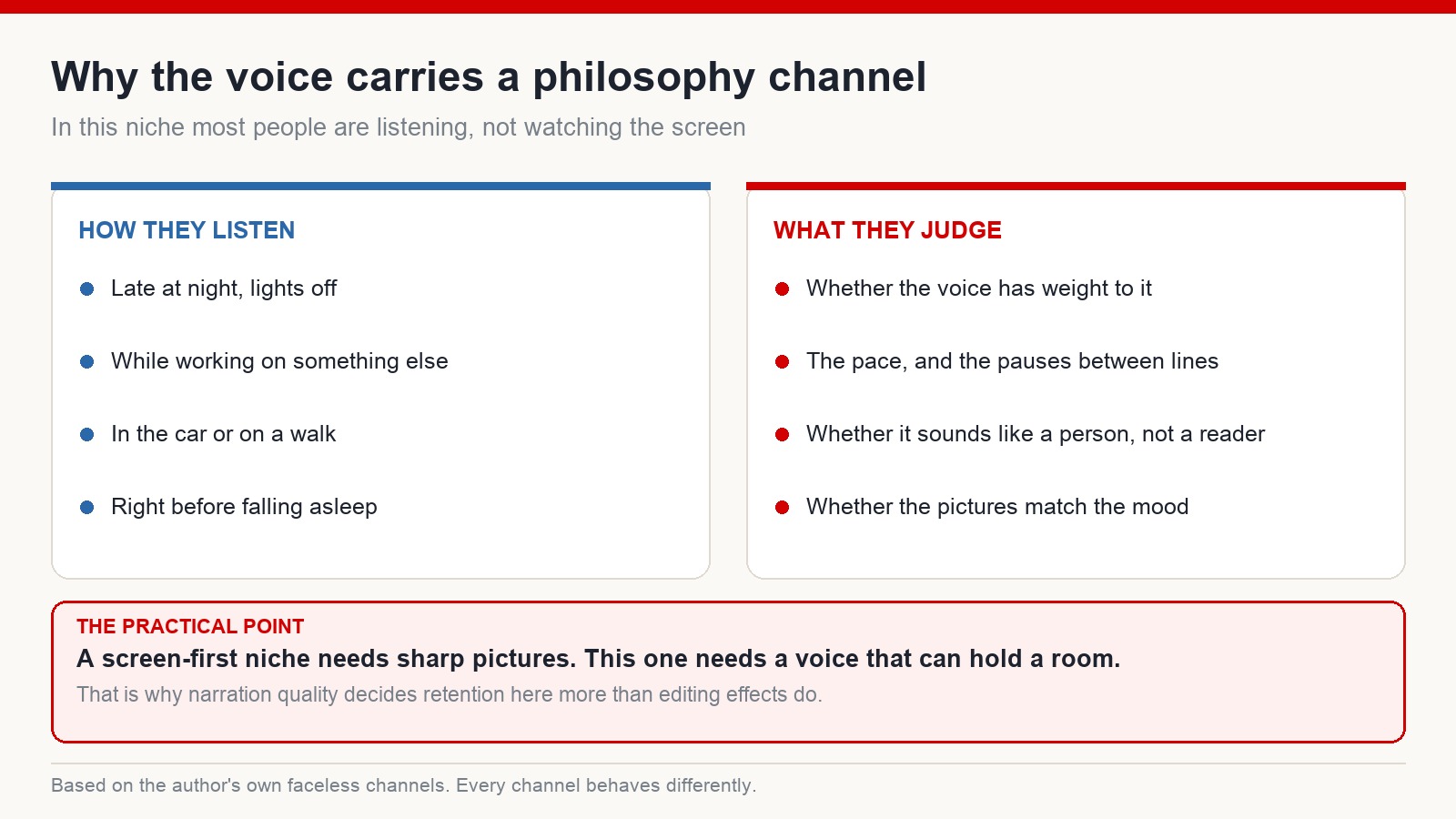
Once you accept that, a lot of production decisions get easier. You stop worrying about transitions and effects, and you start worrying about whether the narration has any weight to it.
Synthetic voices are not where you last left them
If your impression of text-to-speech comes from a few years ago, you probably remember something flat and mechanical. That is a fair memory, and it is out of date.
The current generation of voice models handles natural breaks, sentence stress and a genuine sense of unhurriedness. I am deliberately not going to recommend specific model settings here, because every tool renames and reshuffles them every few months. What matters is the judgement you bring to the tool, and that part does not expire.
Three reasons it fits contemplative content specifically
1. The niche wants a low, slow delivery
Reflective content needs a voice that sounds like it has thought about something before saying it. A quick, high-energy read, the kind that works beautifully for short-form, kills the mood here instantly. Most voice libraries now have several mature, unhurried options, and picking the right one does more for retention than any editing decision you will make that week.
2. People are listening, not watching
Because the screen is often ignored, audio quality carries more weight than image quality. A clean render with sensible pacing will hold someone through a long video. A harsh or rushed one will lose them in the first minute, no matter how good the footage looks.
3. It makes a repeatable production line possible
If you have ever recorded narration yourself, you know how long it takes. You need a quiet room, you need to be in the right frame of mind, and you re-record the same paragraph five times because the emotion drifted. A voice model removes that bottleneck. You can publish on a schedule instead of publishing when your voice and your calendar happen to agree.
The workflow I use for this kind of video
Step 1: study what already holds attention
Not to copy it. To understand it. Take a video in your niche that people finish, read the transcript, and work out what the opening promises, where the turn happens, and how the ending lands. You are looking for structure, not sentences. Reusing someone else’s actual script or footage is a policy problem and a reputation problem; understanding why their structure works is just research.
Step 2: write for the ear, not for the page
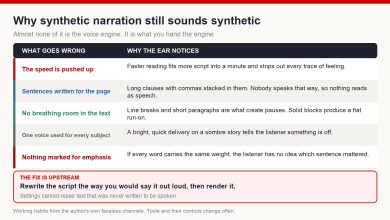
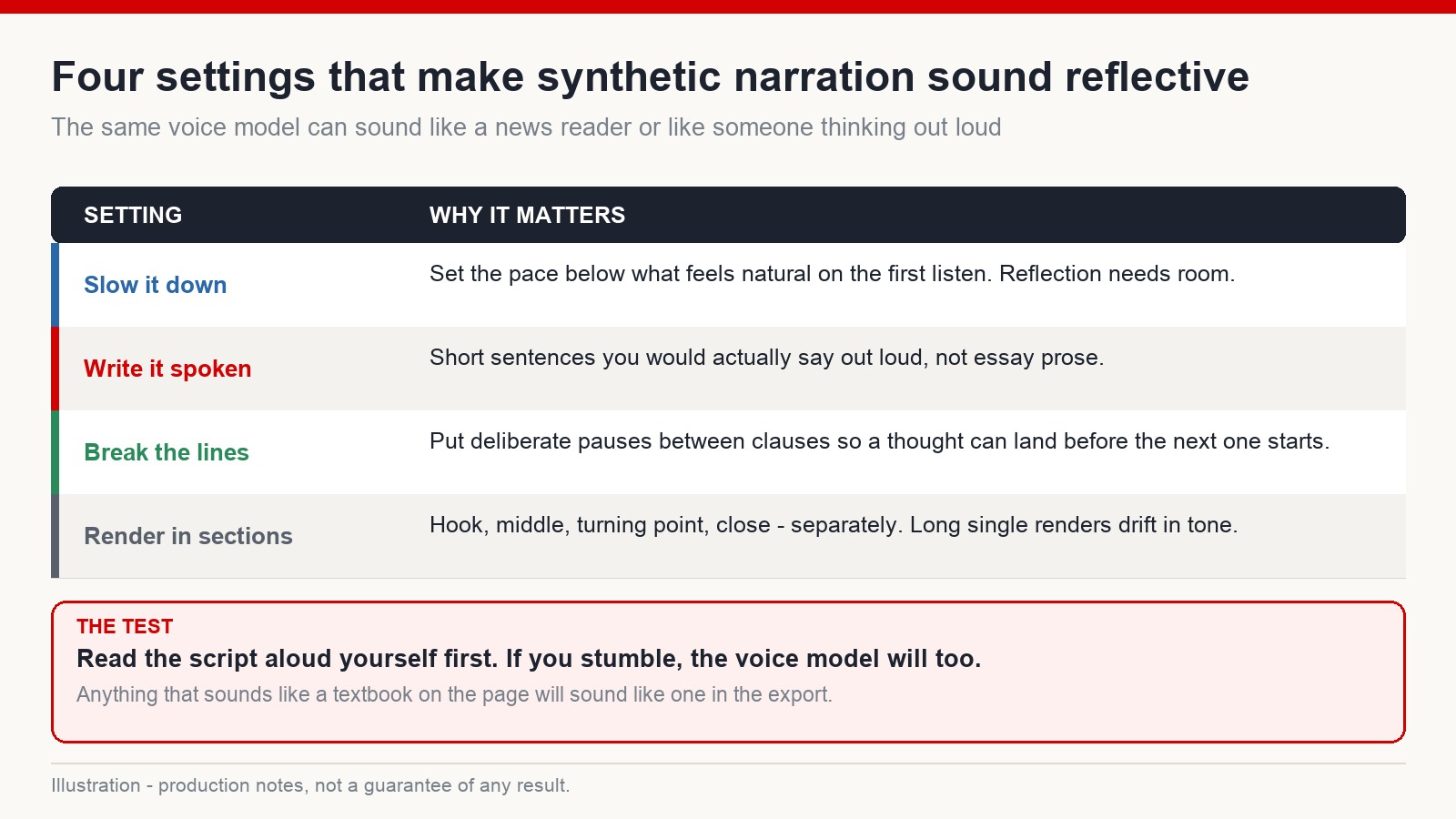
This is the step that decides whether the finished video sounds human. Contemplative content does not work as a list of facts read aloud. It needs short lines, deliberate pauses and room between thoughts.
Something like:
Some people, as they get older, say less.
Not because they have less to say.
Because they have stopped needing to be heard.
Written like that, a voice model will read it the way you would. Written as one long paragraph, the same model will read it like a news bulletin.
Step 3: render in sections
Do not paste a fifteen-minute script in and press generate. Split it: the opening, the middle, the turning point, the close. Long single renders tend to drift in tone, and you only notice once the whole thing is on the timeline. Section by section, you can also re-do one weak paragraph without regenerating everything.
Step 4: match the pictures to the mood
Reflective channels usually lean on slow, cinematic imagery: landscapes, weather, empty rooms, long dissolves. The rule is simple. If the narration is unhurried and the visuals are cutting every second and a half, the two are fighting each other, and the viewer feels the mismatch even if they cannot name it.
Emotion decides retention here, not information
Viewers remember how a video made them feel far more reliably than they remember what it told them. In most niches that is a nice observation. In this one it is the whole job.
It is also why narration quality is not a finishing touch you add at the end. It is the thing you are actually producing. Everything else is packaging around it.
Is this a good niche to build in?
It has real strengths. The audience skews older, tends to watch for longer stretches, and often returns for the next video rather than treating each one as a one-off. Long watch time and repeat viewing are generally good signs for any channel.
I want to be straight about the limits of that, though. Those are tendencies, not a forecast. What a channel earns depends on the market, the topics, the season, and how the platform is pricing attention that month, and none of those are things you control. Treat this niche as a reasonable place to build a body of work, not as a shortcut to a particular number.
Three mistakes that make the video feel fake
Robotic delivery
Too fast, no pauses, even stress on every word. If it reads like a paragraph rather than a person, viewers leave in the first thirty seconds, and they will not come back to the channel either.
Prose that sounds like an essay
This niche needs the texture of lived experience. Long balanced sentences with three clauses each are exactly what generic drafting produces, and exactly what a reflective audience rejects. Cut them in half. Then cut them again.
Visuals that contradict the voice
Rapid cuts, zoom effects and text pop-ups belong to a different format. Here they read as noise. Let the picture sit still and let the sentence land.
A practical test before you commit
Read your own script out loud before you render anything. If you stumble over a sentence, the voice model will too. If a paragraph bores you at your own pace, it will bore a stranger at any pace. This costs five minutes and catches most of the problems that would otherwise reach the timeline.
Why these channels have room to grow
My honest read is that the demand is real. A lot of people are short on quiet and short on the feeling of being understood, and this kind of content speaks directly to that. Meanwhile the production cost has collapsed, so a single creator can now do what needed a small team a few years ago.
That combination is also why the niche is filling up. The channels that will still be here in two years are not the ones with the best software. They are the ones whose narration sounds like a person who has actually thought about something.
Common questions
Does synthetic narration suit a philosophy or reflection channel?
It suits it well, provided you choose a low, unhurried voice and write a script that is meant to be spoken. The voice model is not the weak link; a flat script is.
Do I still need to record my own voice?
No. Plenty of established faceless channels run entirely on synthetic narration. Your own voice is an option, not a requirement.
Will this niche perform well?
It has favourable characteristics, mainly long watch time and a loyal audience. That is not the same as a guaranteed outcome. Results vary by market, topic and execution.
What matters most when using a voice model?
Not the voice. The script, the pacing and the pauses. A natural voice reading a flat script simply reads the flat script clearly.
How long should these videos be?
Long enough to complete a thought and no longer. In practice reflective content tends to run longer than most formats, because the audience is often listening rather than watching, but let the material decide rather than a target number.
Where I would start
If you are considering this niche, do not begin with the tool. Begin with a single script you would be happy to hear read back to you. Then find a voice that can carry it, slow it down further than feels natural, and put quiet images behind it.
A voice with enough weight will hold viewers longer than a complicated edit ever will. If you want to see how I approach building faceless channels for English-speaking audiences more broadly, that is what I work on at mmoyoutube.com.